
NOTE: This site’s physical storymarker will be installed soon! While we wait, discover the storymarker’s content below.
Carp River
Gichi-namebini-ziibiing
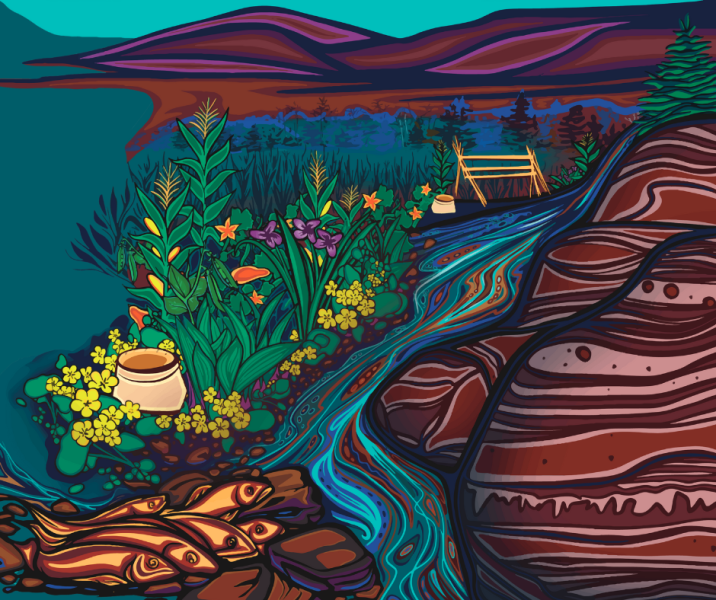
Artists: Sherri Loonsfoot-Aldred & Aiyana Aldred
Artwork Interpretive Statement:
Along the Carp River, the Three Sisters — corn, beans, and squash — grow together, each supporting the others, symbolizing balance and interdependence. Birch bark baskets represent the skill and resourcefulness of the people who lived here, while the rolling Kona Dolomite hills and native plants honor the enduring beauty and abundance of this “forever garden.”
The lengthening days and shifting of ice floes brought an abundant ripple to the water below you. Hundreds of namebin, longnose suckerfish, annually fought the spring melt outflow to swim upriver and spawn in the river bed. Imagine fish so big and plentiful that you could stand here in the Carp River and pull them from the water as they swim past.
Upstream was a large Anishinaabe village called Gichi-namebini-ziibiing that was rich with quartzite quarries where sharps were crafted and forest gardens grew in the fertile soil of the river’s floodplain. The village included a place called gaagige-gitigaan, the “forever garden,” a seasonal place of abundance.
Around you is evidence of more recent history. A well-traveled highway and a water treatment facility were developed to support a growing city. Winding among the trees, trail networks offer our current year-round recreation. Also hidden within the forested ridgelines of pink Kona dolomite stone lies a state maximum security prison established in 1889.
Adjacent to the prison property line, the Carp River flows through public land. Giigoonyikewinini and anglers still wade the waters below in pursuit of a variety of fish. If you see any fishermen in the river, say “aanii,” wave “hi,” and ask if they’ve had any luck!
Namegoshens
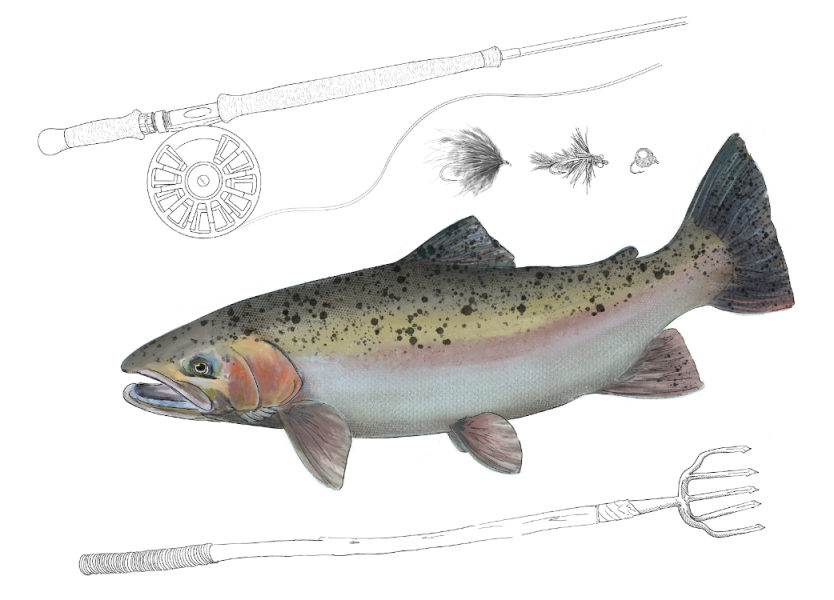
Rainbow Trout (Steelhead)
Oncorhynchus mykiss
Not all non-native species are invasive—some enrich ecosystems.
Rainbow trout and salmon, introduced in the late 19th century, now thrive alongside native fish like walleye and whitefish. Great Lakes fisheries are managed cooperatively by provincial, state, and tribal agencies.
Past the old coal kiln, a trail leads upstream into the wooded hills. Follow the path beneath the highway, away from the sounds of roaring trucks and the waves of Lake Superior. Let the river guide you; what might you find if you give your journey a little extra time?
Links to Learn More:
This section is an ever-growing collection of stories and resources.
If you have suggestions for additional resources or stories related to this site SUBMIT THEM HERE
Interlochen Public Radio story on Indigenous spearfishing and treaty rights: https://www.interlochenpublicradio.org/news/2019-05-30/tribal-citizens-say-harassment-affects-how-they-hunt-fish
Giigoonyag (Fish) Posters – Bizindan Anishinaabemowin (Listen to the language of the Anishinaabe People)
MI DNR Guide to Fishing Lake Superior: https://www.michigan.gov/dnr/-/media/Project/Websites/dnr/Documents/Fisheries/Maps/Roadmap-LakeSuperior-fishing-accessible.pdf
Community Connections:
Have a memory, story, or reflection inspired by one of the shoreline sites? Share your voice! Stories can be personal, historical, or reflective. Submit writing, images, audio, or video – This is the first phase of a living trail—a storytelling project that weaves together public spaces, community voices, history, and art to deepen our connection to the water, land, and people of Marquette.
Each stop along the trail invites you to slow down, reflect, and explore what makes this place meaningful. Through shared stories and creative contributions, we hope to spark curiosity, appreciation, and a stronger sense of belonging.
Your perspective matters. This is a space where all are welcome to share what’s important to them—about this place, its past, its future, and the community we shape together.
Cultural Trail Partners
COMING SOON: Cultural Trail Partners and Knowledge Centers